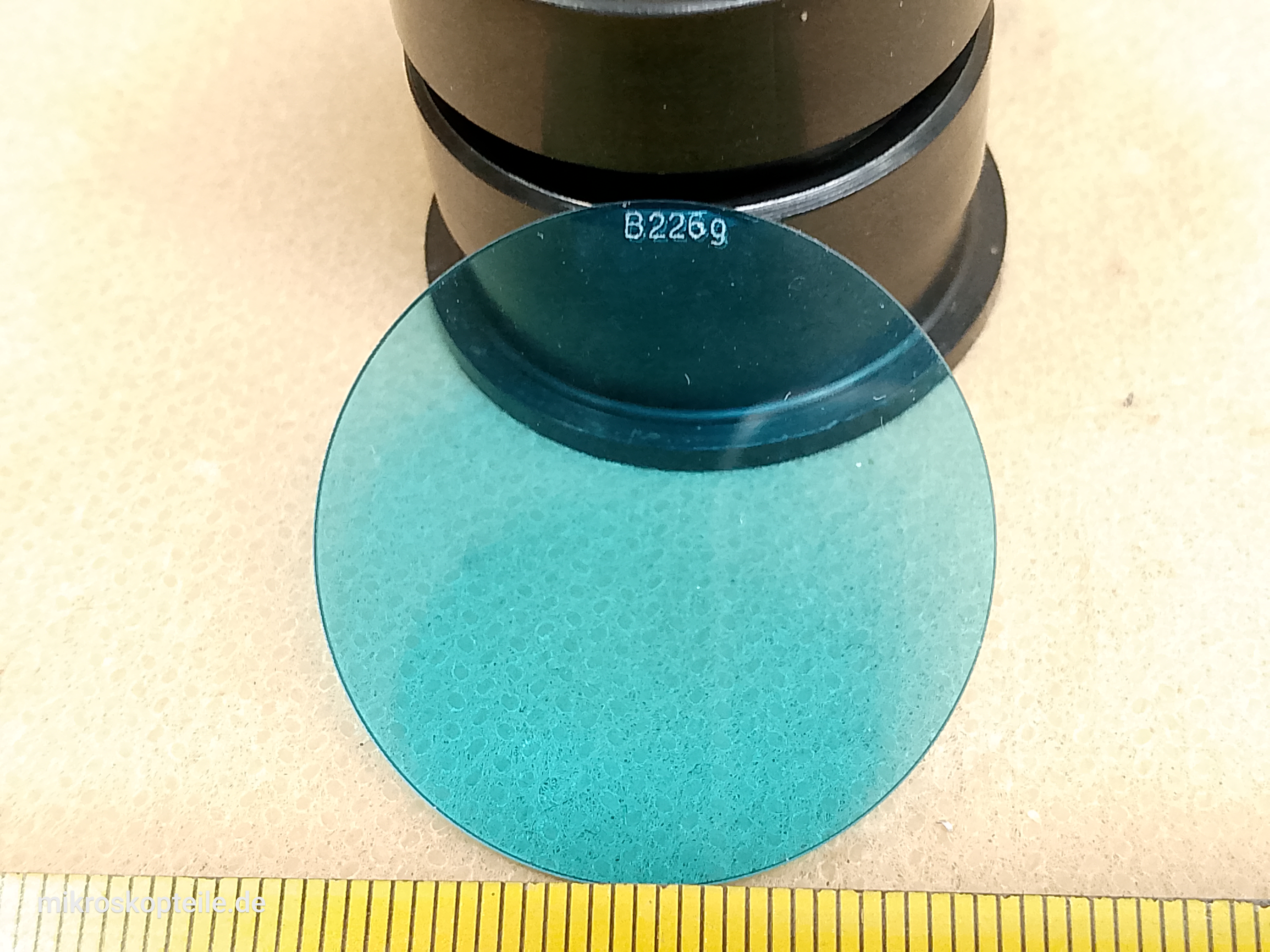
This is description of this part:
Professional blue glass filter Carl Zeiss Jena B226g, 32 mm in diameter, intended for fluorescence microscopy.
Basic parameters of this filter:
Manufacturer: Carl Zeiss Jena
Model: B226g
Filter type: red-absorbing glass filter (the manufacturer calls it Rotsperrfilter)
Glass type: BG 23
Diameter: 32 mm
Thickness: 1 mm
Colour: blue
Toughened version: yes
The letter g at the end of the designation is short for the German gehärtet, meaning toughened - the manufacturer gave it to filters meant to work right next to high-power lamps, especially HBO mercury burners, where ordinary glass does not withstand the high temperature.
Filters 32 mm in diameter can be used in most microscopes from many manufacturers. In Carl Zeiss Jena microscopes they can be used, among others, in the following fluorescence microscopes:
- Carl Zeiss Jena Jenamed Fluorescence (Fluoreszenz)
- Carl Zeiss Jena Jenalumar
- Carl Zeiss Jena Fluoval / Fluoval-2
- Carl Zeiss Jena Laboval Fluorescence
In the excitation path this filter does not work on its own. It is added to the main filter to cut off the red passed by that filter and to narrow the excitation band further. In the manufacturer documentation B226 appears in two such pairs: with the KP490 filter for blue excitation and with the U204 filter for ultraviolet excitation.
Carl Zeiss Jena supplied BG 23 glass in three thicknesses, each with its own designation:
- The Carl Zeiss Jena B226 filter is BG 23 glass 1 mm thick
- The Carl Zeiss Jena B228 filter is BG 23 glass 2 mm thick
- The Carl Zeiss Jena B229 filter is BG 23 glass 3 mm thick
The thicker the glass, the more strongly the red is cut off, but the darker the image as well.
What is this part needed for?
- if you know the B226g specification and this is exactly what you need (for example as an addition to the KP490 or U204 filter)
- if your microscope has a Carl Zeiss Jena B226g filter, but it is cracked, scratched or in very poor condition
- if you already have B228 or B229 and want to complete the set with the thinnest one, so you can match the degree of red absorption to the specimen
- if you want to use this filter in your own DIY project or in a microscope from another manufacturer (for example Leica, Nikon, Leitz Wetzlar or Zeiss West Germany)