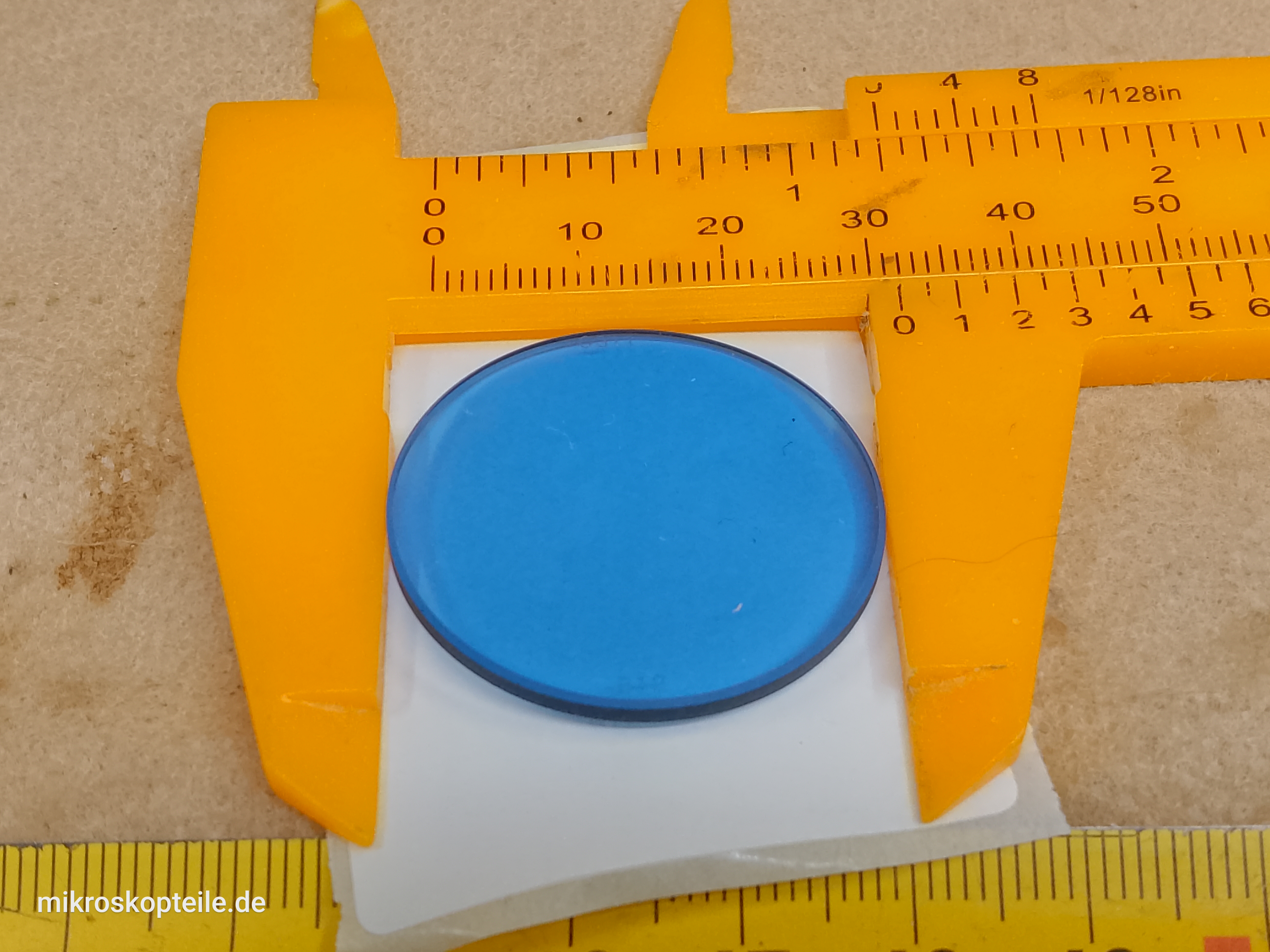
This is description of this part:
Professional blue color filter Carl Zeiss Jena C311 B12 with a diameter of 32 mm, intended for transmitted light microscopy.
Basic parameters of this filter:
Manufacturer: Carl Zeiss Jena
Model: C311 B12
Material: glass
Type of coloring: glass dyed throughout its full thickness, not merely painted on the surface
Tempered glass: no - this model is not recommended for work at high temperatures, for example with HBO mercury burners for fluorescence
Filter type: conversion filter that raises the color temperature of incandescent light to the level of daylight (the manufacturer calls it Konversionsfilter B 12)
Conversion strength: B 12 - the strongest blue filter in the manufacturer's C311 to C313 range
Other name: NCB filter (neutral color balance)
Diameter: 32 mm
Color: blue
The C311 filter was part of the factory equipment of Carl Zeiss Jena microscopes - the equipment catalogues of 1976 and 1981 as well as the instruction manuals recommend it both with 6 V 15 W incandescent bulbs (Carl Zeiss Jena Ergaval and Amplival microscopes) and with halogen lamps (Carl Zeiss Jena Jenaval and Jenamed microscopes).
The effect of this filter is seen, among other situations, when the lamp brightness is turned down with the control knob. Without the filter the light turns orange. With the C311 B12 filter in place the specimen appears lit by a pleasant, almost white light - exactly the kind of light that daylight provides.
Filter discs with a diameter of 32 mm can be used in most microscopes from many manufacturers. The "compatibility" section lists only a few example microscopes in which this filter glass can be mounted.
Depending on the microscope design, the round glass color filter can be fitted:
- in the holder under the condenser
- in the filter turret
- in a mount placed on the illuminator collector
- in a filter slider
What is this part needed for?
- if you know the C311 B12 specification and this is exactly what you need
- if your microscope has a Carl Zeiss Jena C311 B12 filter, but it is cracked, scratched or in very poor condition
- if you want to use this filter in your own DIY project or in a microscope from another manufacturer (for example Leica, Nikon, Leitz Wetzlar or Zeiss West Germany)