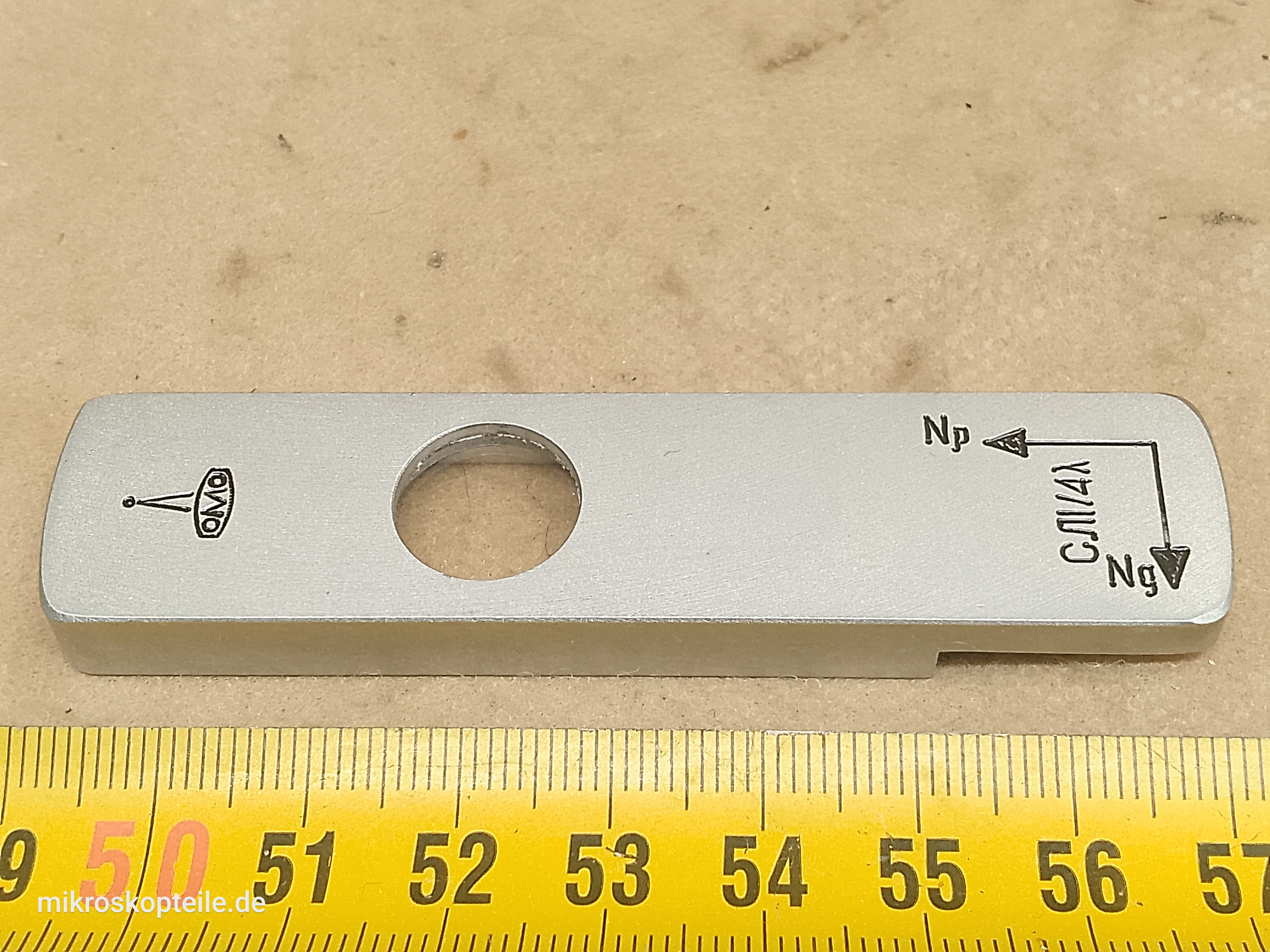
This is description of this part:
LOMO СЛ1/4λ (Latin alphabet transcription: SL1/4lambda) Quarter-wave plate - Sénarmont variant (CP-QS - Compensating Plate, Quarter-wave Sénarmont), perpendicular/parallel axis - for Lomo Polam polarizing microscopes
Lomo microscope compensating slider:
Factory marking: СЛ1/4λ (Latin alphabet transcription: SL1/4lambda)
Alternative name: Sénarmont, CP-QS (Compensating Plate, Quarter-wave Sénarmont)
Crystal material: Mica
Optical retardation: 1/4 lambda (approx. 140 nm)
Orientation of optical axes: perpendicular and parallel to the slider body edge
Dimensions:
Total length: 80 mm
Insertion length: 60 mm
Width: 19 mm
Height: 7,5 mm
Quarter-wave compensating slider of the Sénarmont type (Sénarmont quarter-wave plate) introducing a phase shift of 1/4 wavelength. Unlike the standard quarter-wave plate, in the Sénarmont configuration the crystal axis (Ng) runs parallel to the vibration direction of the polarizer, and the 45-degree effect is enforced by the microscope accessory slot - not by the orientation of the crystal within the body. Used for precise quantitative measurements of optical retardation, determination of the optical sign of minerals, and analysis of elliptically polarized light - in combination with a rotating analyzer and an interference filter (typically 546 nm or 551 nm).
The axes of the fast ray (Np) and slow ray (Ng) are oriented parallel and perpendicular to the edges of the slider body. This arrangement is used in specific types of LOMO microscope heads or with a non-standard (rotated by 45 degrees) polarizer setup, in order to achieve the correct interference effect.
A first variant of this slider is also available - standard quarter-wave plate СЛ1/4λ (Latin alphabet transcription: SL1/4lambda) with diagonal axis (45 degrees), suitable for the vast majority of classic polarizing microscopes with a standard accessory slot. Before purchasing, please check the design of your microscope. Using the incorrect variant will cause the crystal axes to misalign with the vibration direction of the polarized light, preventing proper background extinction as well as precise measurements and conoscopic observations.
What is this part needed for?
- If you have a polarizing microscope and you are missing this compensator on the slider
- If you have this slide, but it's damaged (e.g., delamination)
- If you want to use this quarter-wave plate for other DIY purposes