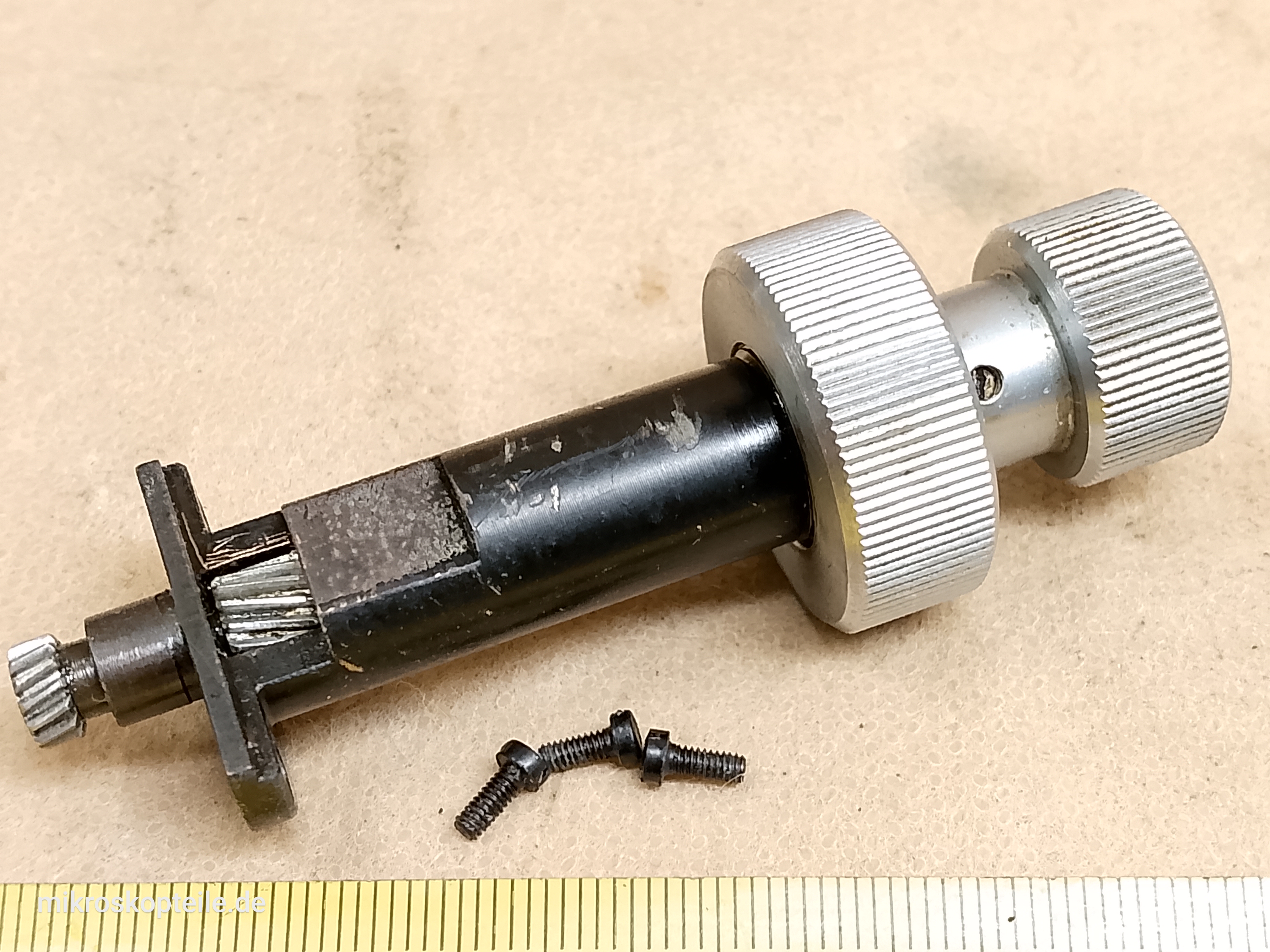
This is description of this part:
Complete manipulator of the PZO SK14 mechanical XY stage for PZO Biolar microscopes and similar stands.
This is a complete control assembly for a mechanical microscope stage, allowing the specimen to be moved precisely in both the X and the Y axis of the stage plane. The manipulator consists of two coaxial knobs and two coaxial drive shafts - an outer one and an inner one - ending in separate pinions of different diameters.
This particular stage drive was removed from a PZO SK14 microscope stage. The last photo in the gallery shows the complete stage it comes from.
Please note: SK14 is the model of a stage made by PZO (SK = Stolik Krzyżowy, Polish for cross stage). The model marking (the wording "SK14") is located on the stage itself. This stage was most often fitted to PZO Biolar microscopes, which carry no model name on the body. As a result "SK14" is the only marking present on the microscope, and many people - wrongly - use the name "PZO SK14" for the whole microscope. That is a mistake: PZO SK14 is the model of the stage, not of the microscope.
This handle is 62 mm long (plus 3 mm for the flange holding the three screws that fasten the handle to the rest of the stage).
The SK14 microscope stage this manipulator handle comes from was fitted to a PZO Biolar B microscope. The same stage model was, however, also used in other Biolar models and in other microscopes of this manufacturer, for example:
- PZO Biolar DIC
- PZO Biolar B2
- PZO Biolar GF
- PZO Biolar FL
- PZO MB 30 / MB 30S / MB 30 FL
- PZO Studar
On the second-hand market and in service documentation one encounters many names referring to this assembly. The most commonly used terms include, among others:
- stage manipulator
- XY stage manipulator
- mechanical stage drive
- stage control knobs
- specimen mover
- coaxial stage drive
- stage drive assembly
- mechanical stage control
- manual XY stage drive
- stage actuator mechanism
Manipulators of this kind are very often damaged mechanically while the microscope is being transported. Because they stick out beyond the outline of the stand, they are the first to take the impact energy when the instrument is dropped or packed badly.
In many cases it is not the whole manipulator that gets damaged, but only one of its elements. Most often these are the knobs, the drive shafts, the coaxial sleeves or the fixing elements. That is why this database also holds all the key components of this manipulator (and of others), offered separately as service parts.
A damaged stage drive does not make further work with the microscope impossible. The specimen can be moved by hand, or a simple specimen holder without an XY movement mechanism can be fitted. Such a solution works well at low magnifications, but when working with objectives with magnifications above 40x (for example 60x, 63x, 80x or 100x) moving the specimen precisely by hand becomes very difficult. At total magnifications above roughly 400x, even a slight movement of the hand shifts the image by a considerable distance across the field of view. A mechanical stage drive allows the specimen to be moved very smoothly, in a controlled and repeatable way in both axes, which matters especially during oil immersion observation and when taking photographic documentation.
This element is not a part for repairing the microscope. It is an element of the microscope stage - and the stage can be used with any compatible PZO microscope.
The gallery holds detailed photos of this handle with its knobs. Every photo includes a scale with a millimetre graduation. The last photo shows the complete PZO SK14 microscope stage, with an arrow pointing to the element in question and to its location in the stage, so that the part can be identified beyond doubt.
What is this part needed for?
- if you have an incomplete stage with this manipulator missing (for example somebody did not finish the repair)
- if you have a stage in which the manipulator does not work or is in very poor condition (it turns stiffly or unevenly)
- if you need a precise coaxial mechanism for your own DIY project, for example something related to macro photography or to rotating an object for 3D films