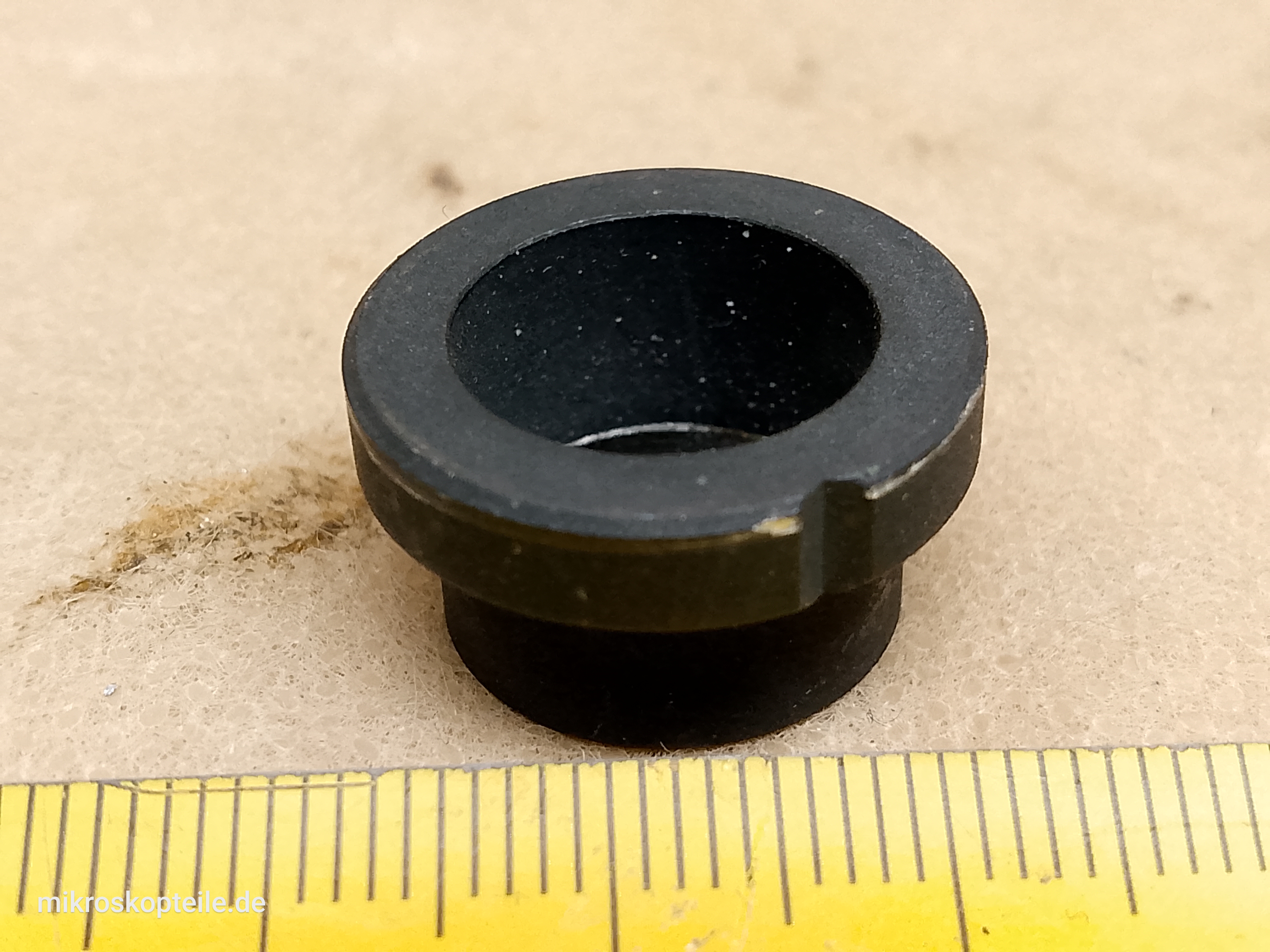
This is description of this part:
Polarising phase annulus for a 40x objective, for the PZO KS stereoscopic phase contrast condenser, compatible with PZO K3Ph, K3PhZ and other condensers.
Basic parameters of this phase annulus:
Position in the condenser: phase annulus to be fitted in the "40x" position of a turret condenser, to be paired with the phase ring in a 40x phase contrast objective
Construction: disc with a phase annulus in a mount
Material: glass, colourless polarising film and printed black circles
Diameter of the glass disc with the printed annulus: 14 mm
Disc mount: metal, with a notch for the spring-loaded ejector pin
Spring cushioning: no - the mount of the 40x phase annulus has no spring cushioning
Other names: phase disc, phase glass, phase ring
Intended for: PZO KS condenser
Compatibility: PZO K3Ph, K3Ph1, K4Ph and K3PhZ phase contrast condensers
Important note on appearance: the black dots and lines visible in the photo are not a surface defect - this is how PZO phase rings normally look
Note on the polarising film: two pieces of polarising film are glued onto the annulus. The vertical line running through the middle of the annulus is where these two films meet - it is neither a defect nor a crack, even though it looks like one
Over the years the polarising film used on these phase annuli very often came unstuck (delamination), which often - though not always - caused it to lose its properties and made stereoscopic contrast completely unusable. In such a case you can either:
- peel off the old film, clean the surface of the glass disc and glue on a new one, keeping the polarisation angle
- or replace the whole disc with one like the one offered here.
The specific feature of the PZO KS is that the ring of every disc is divided into two equal halves by two polarisers set perpendicular to each other. By rotating the analyser you extinguish one half of the ring and brighten the other - smoothly, without moving anything in the optical path. The specimen is then illuminated from one side.
And this is exactly how the disc from the KS condenser differs from the discs of the PZO K3Ph, K3Ph1, K4Ph and K3PhZ condensers. Mechanically it is the same insert, 14 mm in diameter, and it fits those condensers. The difference lies solely in the polarisation of the ring itself, described above. That is why a KS disc used in an ordinary phase condenser still gives correct phase contrast with no loss of quality, but once an analyser is placed in the optical path (for example under the head) it can produce interesting, unexpected effects.
For DIY enthusiasts looking for new, unusual visual effects in microscopy, an interesting option is to fit this polarising phase annulus into a different phase contrast condenser. You can then explore the unusual behaviour of various objectives in partially polarised light.
Here is an example: a Zernike-type phase contrast objective (PZO Ph with a green stripe) combined with the phase annulus from the PZO KS condenser gives an unusual, bluish background colour (https://www.facebook.com/photo?fbid=1262188377207557&set=a.462747092529893). And here you can see PZO microscope objectives for six types of phase contrast: https://www.facebook.com/MikroskopyPZO/photos/por%C3%B3wnanie-obiektyw%C3%B3w-pzo-20x-do-kontrastu-fazowego-pier%C5%9Bcienie-zielony-ph-kf-do/1259433520816376/.
The PZO KS condenser was fitted to PZO MB-30S microscopes and was an essential part of a special phase contrast method called "Stereoscopic Contrast" (KS). This condenser is characterised by carrying no markings at all - and that is how you recognise it.
Fastest way to recognise the PZO KS condenser:
PZO KS condenser: no serial number, no manufacturer name or logo, no model designation
Other PZO phase contrast condensers: at least a printed model designation (for example KFF, KFL, K3Ph, K3Ph1, K4Ph, K3PhZ, or KPI 2 in the case of the DIC condenser)
What is this part needed for?
- as a service part for repairing the PZO KS stereoscopic phase contrast condenser, if you own one with a damaged 40x phase annulus
- for DIY enthusiasts looking for new visual effects in light microscopy