More about part: Zeiss (West Germany) microscope Ph3 fluorescence-polarization phase annulus insert | phase condenser PH-diaphragm ring (ID: 99641)
Zeiss (West Germany) microscope Ph3 fluorescence-polarization phase annulus insert | phase condenser PH-diaphragm ring




Main Photo
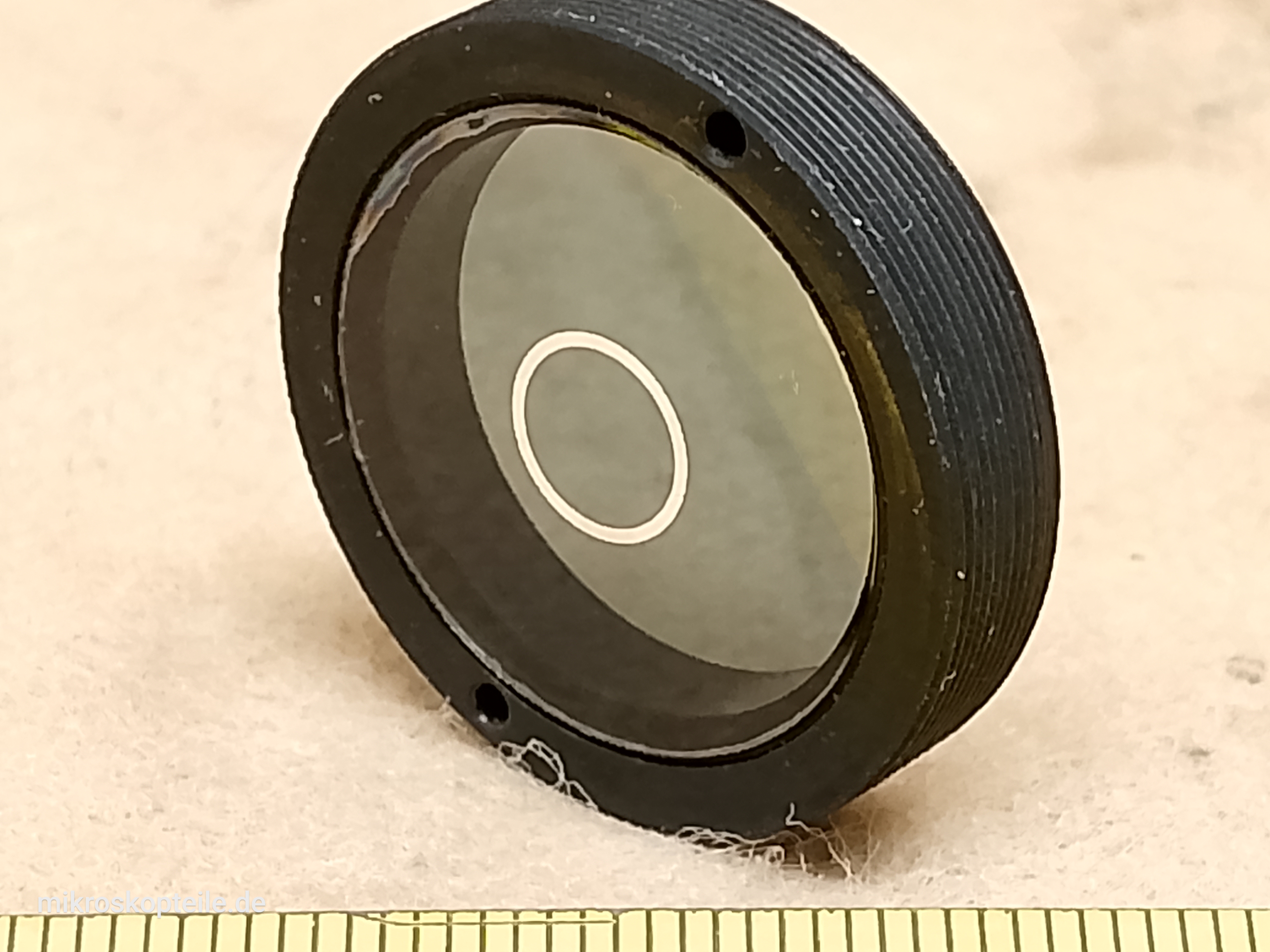
Description
Zeiss (West Germany) microscope Ph3 fluorescence-polarization phase annulus insert | phase condenser PH-diaphragm ringReplaceable PH3 phase contrast annulus (diaphragm) with retaining ring for Zeiss West Germany phase contrast condensers intended for fluorescence-polarization applications.
Replaceable diaphragms (both for phase contrast and darkfield) for phase contrast condensers allow the condenser to be configured individually. Thanks to this, it can support exactly the observation techniques and exactly the microscope objectives that are required.
Important: by installing the fluorescence-polarization diaphragm presented here, a condenser currently equipped with standard phase contrast diaphragms can be upgraded with this unique function. A detailed description of the capabilities offered by this technique is provided below.
Basic parameters of this phase contrast diaphragm:
- Manufacturer
- Carl Zeiss (Oberkochen, West Germany)
- Condenser marking
- "3". On the Zeiss condenser P/N 46 52 78 this position is marked in blue
- For microscope objectives
- to obtain phase contrast operation, use microscope objectives marked "Ph3", i.e. objectives with magnifications from 40x to 100x
- Substrate material
- glass mounted in a metal holder with a flange
- Ring material
- polarizing film
- Outside diameter of the retaining ring
- 28 mm
- Retaining ring height
- 6 mm
Important: this component (phase contrast annulus / phase contrast diaphragm) is not intended for a specific microscope model. It is a component for upgrading or repairing a microscope phase contrast condenser. It is not intended for upgrading or repairing any specific condenser model. Many Carl Zeiss condenser models have a matching opening into which this phase contrast annulus can be installed.
▼ More about this microscope part
In the Carl Zeiss condenser P/N 46 52 78, the phase annuli in positions 2 and 3 are not ordinary openings in an opaque mask but openings in a polarizing film. The polarization direction of these annuli is N-S, so the direct light beam that forms the phase contrast image is linearly polarized. Since it is polarized, its intensity can be adjusted continuously with a second polarizer – without any mechanical parts, diaphragms or shutters.
This second polarizer can be any pair of rotatable polarizing filters. In the original Zeiss design, this is the Carl Zeiss light control unit P/N 47 72 20 with two independently rotatable polarizers mounted beneath the condenser. This makes it possible to switch on phase contrast while simultaneously reducing the illumination intensity to a safe level.
- when the polarizer is aligned parallel to the N-S axis of the annulus – full transmission, maximum phase contrast beam, full-strength phase contrast image;
- when the polarizer is crossed (E-W) – the annulus "goes dark", the objective phase plate no longer receives the direct beam, and the phase contrast image disappears;
- when the polarizer is set to intermediate positions – smooth adjustment of the contribution of the phase contrast image.
When the illumination source is a fluorescence lamp (or, of course, an LED FL light source), simply rotating the polarizer beneath the condenser (together with removing the excitation filter) allows the user to switch from a fluorescence image to a conventional phase contrast image. With the polarizer crossed and the excitation filter installed, the phase annulus is extinguished and only pure fluorescence is visible; as the polarizer is rotated, the phase contrast image gradually increases and is superimposed on the fluorescence image. The second polarizer in unit P/N 47 72 20 is additionally used to attenuate the overall illumination intensity (to protect the specimen or to control the specimen's exposure to fluorescence light).
And now an interesting note from the Ultraphot-shop website [[ LINK ]], © Spike Walker 2007:
Because the annulus is a linear N-S polarizer, it can be used to produce coloured phase contrast: when a two-colour polarizing filter (Cokin type) is placed between the microscope polarizer and the condenser annulus, the specimen takes on the colour of the illuminating annulus against the background colour of the remaining part of the disc – for example, an orange specimen on a green background when using a red-green filter.
This particular phase contrast annulus was removed from a fluorescence phase contrast condenser – an older version of the Zeiss condenser P/N 46 52 78. Before deciding to install it in your condenser, carefully compare the shape of its housing and the dimensions of the retaining ring.
The last photograph in the gallery shows the turret from a Zeiss phase contrast condenser. The arrow indicates the phase contrast annulus offered here, already installed.
Manufacturer
Zeiss - (Carl Zeiss West Germany) ➔ All parts
It comes from
Why do you need this?
- if the PH3 fluorescence-polarization diaphragm in your Zeiss phase contrast condenser has been damaged
- if you have a Zeiss phase contrast condenser equipped with a set of standard phase contrast diaphragms (phase annuli) and would like to upgrade it for fluorescence phase contrast applications
- if you would like to use this PH3 phase contrast diaphragm in your own DIY project, for example to use a Zeiss Ph2 microscope objective on another microscope
Compatibility
This microscope part is compatible with the following microscope models:
- Zeiss Photomicroscope II
- Zeiss Photomicroscope III RS
- Zeiss Standard 14
- Zeiss Standard GFL
- Zeiss Standard WL
- Zeiss Standard 16
- Zeiss Universal
- Zeiss Photomicroscope
- Zeiss Ultraphot
- Zeiss Standard 20
- Zeiss Standard 25