More about part: Carl Zeiss Jena Planachromat 25x/0,50 oo/0 Ph - EPI phase contrast microscope objective M19 | Neophot 21 reflected light (ID: 91058)
Carl Zeiss Jena Planachromat 25x/0,50 oo/0 Ph - EPI phase contrast microscope objective M19 | Neophot 21 reflected light





Main Photo
Description
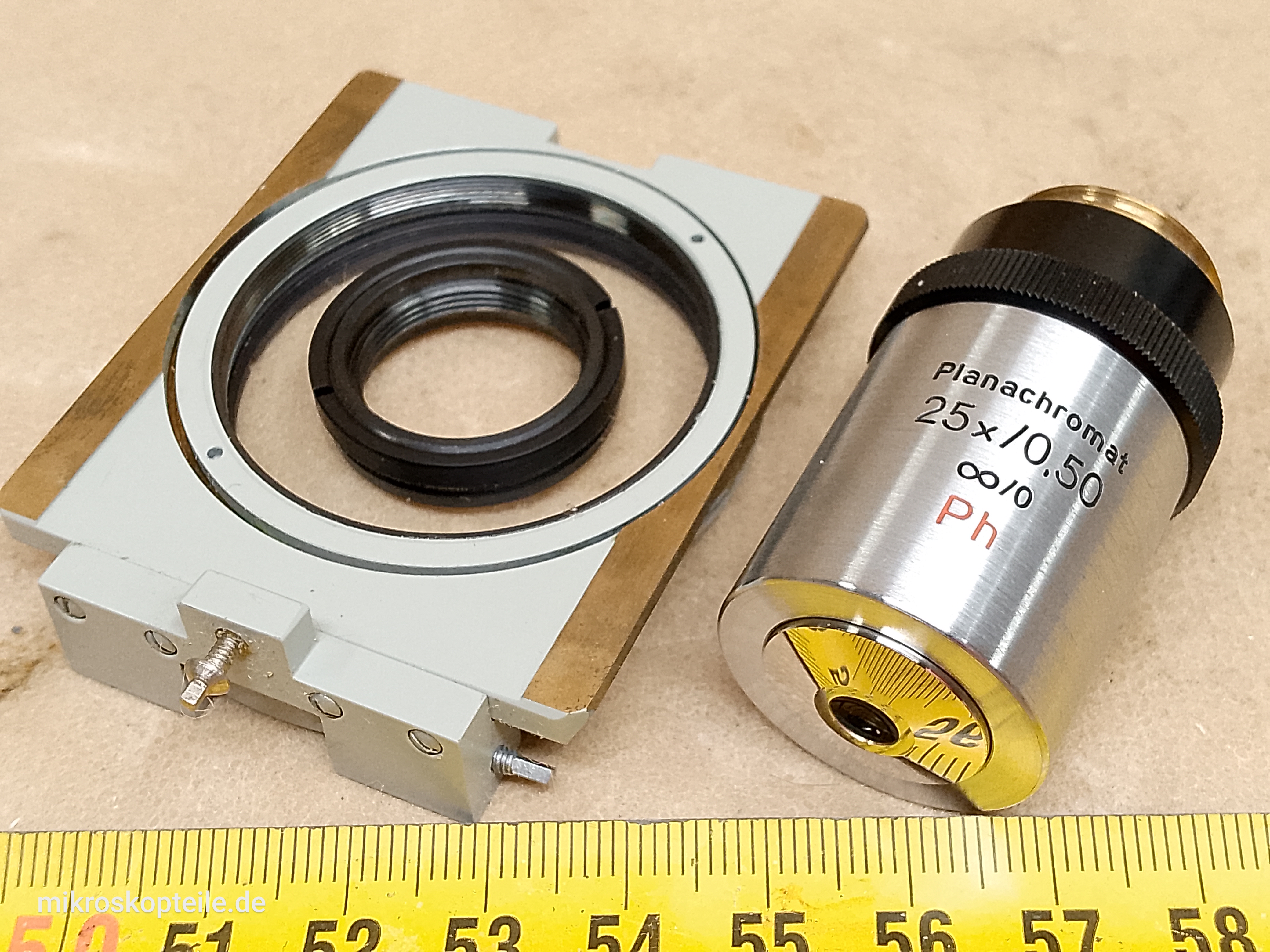
Carl Zeiss Jena Planachromat 25x/0,50 oo/0 Ph - EPI phase contrast microscope objective M19 | Neophot 21 reflected lightCarl Zeiss Jena Planachromat 25x microscope objective with a special kind of phase contrast for work in reflected light (EPI), intended for the Carl Zeiss Jena Neophot 21 microscope.
Basic parameters:
- Manufacturer
- Carl Zeiss Jena
- Engraving on the objective
- Planachromat 25x/0,50 ∞/0 Ph
- Magnification
- 25x
- Numerical aperture N.A.
- 0,50
- Tube length
- infinity (more precisely: 250 mm)
- Optical correction
- planachromatic
- Cover glass
- no - this objective is intended for work without a cover glass
- Immersion
- no - this is a so-called dry objective
- Phase contrast
- yes, a special phase contrast for work in reflected light
- Polarisation
- no - this is not a polarising objective
- Thread
- M19
- Plan compensating eyepieces
- yes, required - this objective needs eyepieces with additional correction (marked "PK" at Carl Zeiss Jena)
- Direct projection and macro photography
- no - this objective does not work in direct projection mode and is not suitable for macro photography with the objective attached directly to a camera
Phase contrast objectives for the Neophot microscopes have a phase ring built differently from the other Ph objectives made by Carl Zeiss Jena - instead of a continuous ring there is a three-segment pattern, somewhat reminiscent of a Wankel engine rotor. This is worth knowing, because it means that a phase contrast objective from a biological microscope will not replace this one in a Neophot, and the other way round.
The reason is a matter of design. In a metallurgical microscope the objective also acts as the condenser, so the illuminating light passes through the same pupil as the light forming the image. With a continuous ring the whole illumination would pass through the phase coating, which lets only part of the light through and reflects a fair amount of it - and those reflections would swamp the already faint phase contrast image. The solution turned out to be an odd number of segments: the image of the diaphragm formed after reflection off the specimen is rotated by 180 degrees, so with three segments it falls into the gaps between them. The illuminating light therefore enters beside the phase coating and returns through it. The solution is described in patent AT 295883 B.
The objective is offered together with its matching slider (Objektivwechselschlitten) with an M19 thread - and that is no coincidence. The position in which the phase sectors come to rest is decided by how far the objective screws into the thread, and every specimen stops slightly differently, which is why the factory selected objective and slider in pairs and wrote both numbers on the card in the case. Buying such a pair together avoids the whole problem - the objective already sits in relation to its slider exactly as it left the works.
Setting it up in the microscope needs neither a service technician nor a phase telescope - the Neophot has a built-in, swing-out Bertrand lens. The procedure is basically this: switch in the Bertrand lens, focus on the phase sectors and use the adjusting screws to bring the image of the sector diaphragm into coincidence with the image of the sectors in the objective; sometimes a slight rotation of the aperture diaphragm helps as well. Should the position of the glass in the sector diaphragm itself ever need correcting - it is held down by an ordinary threaded ring, so it can be turned. The whole thing resembles centring the phase rings in the condenser of a biological microscope.
Two more things are needed on the microscope side for work in phase contrast: the sector diaphragm (Sektorenblende), pushed in front of the open aperture diaphragm, and the auxiliary lens turret (Hilfslinsenrevolver) on the dovetail of the illuminator. The latter images the diaphragm exactly in the plane of the phase coating, which lies slightly differently in each objective - hence a separate auxiliary lens for every magnification. In bright field the objective of course works perfectly normally.
A note for the DIY-minded: an objective like this can be adapted for transmitted light, except that the diaphragm in the condenser is then set not opposite but in line with the segments of the objective, because there is no second pass through the pupil. Phase contrast should appear, but with stronger halo and a directional relief effect, since the gaps in the ring mean that part of the illumination azimuths is missing. On top of that comes the infinity design with no cover glass correction, so a tube lens will be needed. More of an experiment than a working solution - but doable in one evening.
The last photos in the gallery show:
* a photo of the original table indicating which serial numbers of the objective sliders are factory-paired with which serial numbers of the objectives
* two pages of errata to the instruction manual of the Carl Zeiss Jena Neophot 2 microscope.
The "compatibility" section lists, besides the Carl Zeiss Jena Neophot 21 microscope, those microscopes that this objective fits mechanically and optically. What result you get on them, however, can sometimes be a surprise.
Here ([[ LINK ]]) is the same objective in the version without phase rings. Its description tells you more about using Carl Zeiss Jena objectives with an M19 thread.
Manufacturer
Carl Zeiss Jena - (VEB Carl Zeiss Jena DDR (former East Germany)) ➔ All parts
It comes from
This part was removed from the following microscope:
Why do you need this?
This microscope part is typically used for the following purposes:
- if you own a Carl Zeiss Jena Neophot 21 microscope with phase contrast but are missing the 25x objective from the set
- if you own the complete set but your 25x objective is damaged or in very poor condition
- if you like to be prepared and want such an objective in reserve, as it rarely turns up on the second-hand market
- if you are putting together a phase contrast set of this kind yourself and sourcing every part separately
- if you need an objective of this magnification for one of the microscopes it works with (further details are given in the description)
Compatibility
This microscope part is compatible with the following microscope models:
- Carl Zeiss Jena Neophot 21
- Carl Zeiss Jena NU
- Carl Zeiss Jena NU-2
- Carl Zeiss Jena Amplival
- Carl Zeiss Jena Vertival
- Carl Zeiss Jena Lumipan
- Carl Zeiss Jena Nf
- Carl Zeiss Jena Epival
- Carl Zeiss Jena Polmi A
- Carl Zeiss Jena BK 70x50
- Carl Zeiss Jena Epignost
- Carl Zeiss Jena Epityp-2
- Carl Zeiss Jena Metaval
- Carl Zeiss Jena Amplival Pol
- Carl Zeiss Jena Amplival Interphako
- Carl Zeiss Jena Peraval