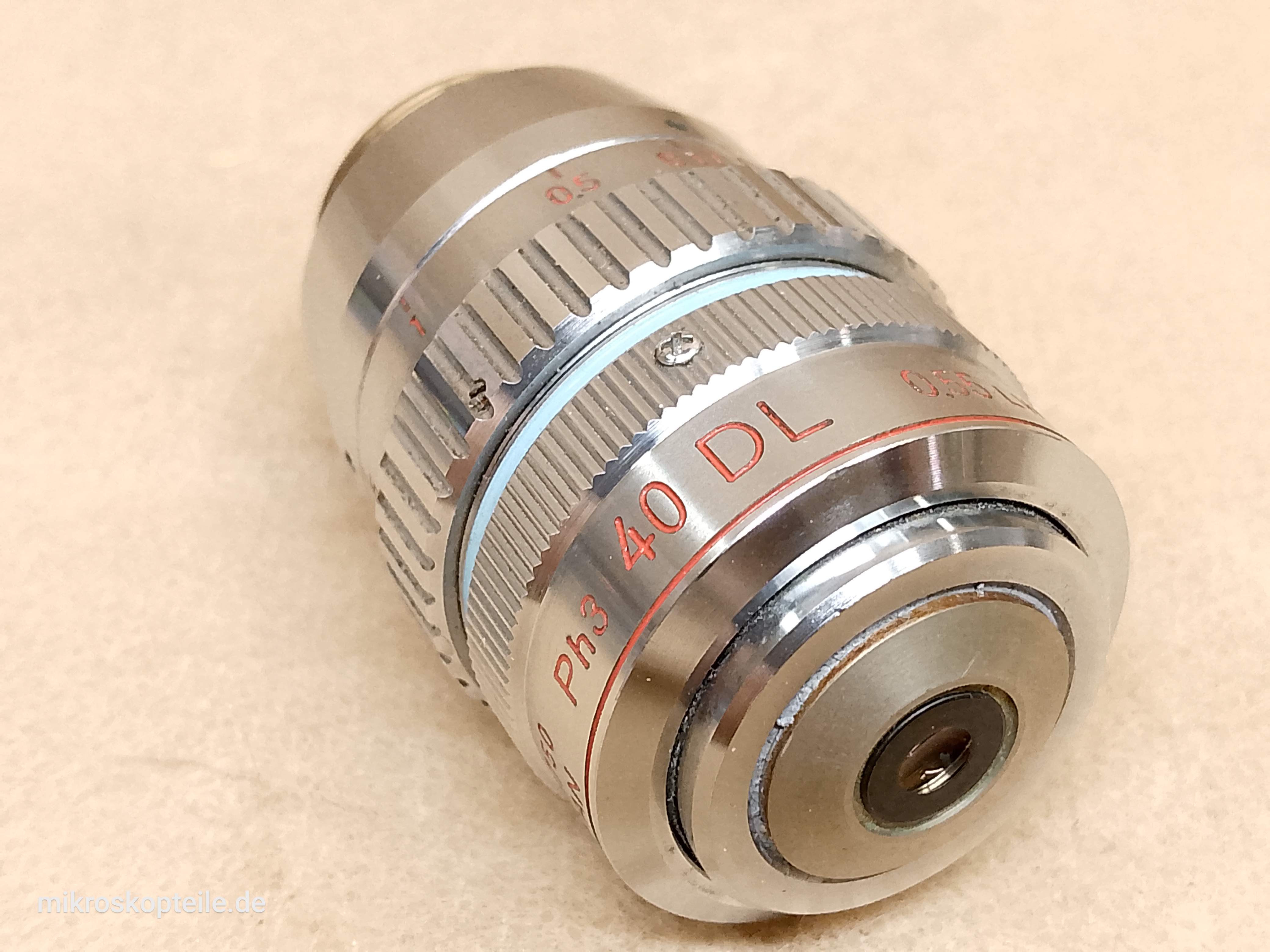
More about part: Nikon TMS / Labophot-2 Microscope Ph3 40 DL 0.55 LWD 160/0-2 Objective | 40x Phase Contrast with Long Working Distance and Correction Collar (ID: 99823)
Nikon TMS / Labophot-2 Microscope Ph3 40 DL 0.55 LWD 160/0-2 Objective | 40x Phase Contrast with Long Working Distance and Correction Collar



Main Photo
Description
Nikon TMS / Labophot-2 Microscope Ph3 40 DL 0.55 LWD 160/0-2 Objective | 40x Phase Contrast with Long Working Distance and Correction CollarAchromatic Nikon Ph3 DL 40x / 0.55 LWD microscope objective for brightfield and phase contrast, with 0 - 2.0 mm correction collar, for 160 mm tube length - for inverted and upright biological microscopes, made in Japan.
Basic objective parameters:
- Manufacturer
- Nikon, Japan
- Model
- Ph3 40 DL 0.55 LWD 160/0-2
- Magnification
- 40x
- Numerical aperture (N.A.)
- 0.55
- Optical correction
- achromat
- Phase contrast
- Ph3 DL - Ph3 indicates the size of the phase ring (requires a matching Ph3 annulus in the condenser), DL (Dark Low) means dark, i.e. positive phase contrast - the object appears darker than the background
- Working distance (WD)
- ~2.1 - 2.5 mm - LWD (Long Working Distance)
- Correction collar
- compensates for cover glass or vessel bottom thickness in the range 0 - 2.0 mm
- Cover glass
- the objective can be used without a cover glass, with a standard cover glass approx. 0.17 mm thick, and also with specimens observed through the bottom of a Petri dish up to 2.0 mm thick
- Immersion
- no (dry objective)
- Tube length
- 160 mm
- Parfocal length
- 45 mm
- Thread
- RMS
- Optics
- CF (Nikon CF-160) - requires no compensating eyepiece and allows photography by direct projection
This objective is suitable for:
- inverted microscopes - observation through the bottom of a Petri dish or cell culture flask
- upright biological microscopes - observation of specimens with or without a cover glass
Phase contrast work requires a compatible phase contrast condenser or a slider with a phase contrast annulus.
Commonly used, inexpensive cover glasses are 0.17 mm thick mainly in theory. Even the standard for class #1.5 allows a range of 0.16 - 0.19 mm, and in cheap Chinese cover glasses you will find in practice pieces from approx. 0.13 to 0.25 mm, often not matching the thickness stated on the box. Only #1.5H (high precision) cover glasses have a guaranteed thickness of 0.170 mm with a tolerance of +/- 0.005 mm. Variation in cover glass thickness clearly degrades image contrast and resolution (spherical aberration). The correction collar fitted to the objective offered here lets you adjust the optics to the combined thickness of the cover glass and the medium layer beneath it. This compensates for most of the variation found in practice.
In addition, the correction collar of this objective can be set to "0" for work without a cover glass, or to large values (up to 2.0 mm) to adapt the optics to observation through a microscope slide (0.8 - 1.2 mm), a glass Petri dish (usually 1.5 - 2.0 mm - thicker dishes are outside the collar range) or a plastic Petri dish (usually approx. 1 mm, in the range 0.8 - 1.2 mm).
This objective fits practically any microscope from any manufacturer, provided it has an RMS thread and uses objectives for 160 mm tube length with a parfocal length of 33, 37 or 45 mm. Some example microscopes are listed in the "compatibility" section, but the list is not complete.
Manufacturer
Nikon - (Nikon Instruments (Nikon Corp.)) ➔ All parts
It comes from
This part was removed from the following microscope:
Why do you need this?
This microscope part is typically used for the following purposes:
- if your microscope is missing a 40x objective - for brightfield or phase contrast
- if you observe cell cultures, algae, protozoa or fungi in Petri dishes on an inverted microscope
- if a standard 40x objective cannot focus through the thick bottom of a Petri dish or culture flask, or touches the vessel
- if you want to observe living, unstained specimens in phase contrast
- if you need an objective with correction for cover glass or vessel bottom thickness
- if you work with specimens without a cover glass
- if you want to photograph specimens by direct projection
- if you already have such an objective, but it is damaged or of very poor quality
Compatibility
This microscope part is compatible with the following microscope models:
- Nikon TMS
- Nikon Optiphot-2
- Nikon Labophot-2
- Carl Zeiss Jena Amplival
- Carl Zeiss Jena Ergaval
- Carl Zeiss Jena Docuval
- Carl Zeiss Jena Nf
- Carl Zeiss Jena Ng
- Carl Zeiss Jena Eduval
- Carl Zeiss Jena Eduval-4
- Carl Zeiss Jena Laboval
- Carl Zeiss Jena Laboval-2
- Carl Zeiss Jena Laboval-3
- Carl Zeiss Jena Laboval-4
- Carl Zeiss Jena Laboval Pol
- Carl Zeiss Jena Laboval Fluorescence
- Carl Zeiss Jena Fluoval-2
- Zeiss Standard WL
- Olympus BH-2 BHS
- Olympus CK2
- Olympus BHA
- Olympus CH-2 CHT
- Olympus BH-2 BHTU
- PZO Biolar DIC
- PZO Biolar
- PZO Studar
- PZO MB-30
- PZO MS4
- PZO ML4
- PZO ML5
- PZO ML6
- PZO MS6
- PZO Biolar FL
- PZO MB 30S
- Vickers Patholette
- Lomo MICMED-2
- Lomo MIN-8
- Lomo MBB-1
- Lomo Biolam
- Lomo Polam R-113
- Lomo Polam L-211
- Lomo Polam LMPR
- Lomo Polam R-311
- Lomo Biolam D11
- Lomo Polam L-213
- Lomo MBP-1
- Lomo Erudit
- Lomo Biolam 70
- Zeiss Standard 14
- Zeiss Standard GFL
- Zeiss Standard WL
- Zeiss Standard 16
- Zeiss Universal
- Zeiss Photomicroscope
- Zeiss KF 2
- Zeiss Ultraphot
- Meopta DRU-3
- Meopta RU2
- IOR Biorom
- IOR ML-4M
- IOR MC-7
- Hertel & Reuss Studio C
- Hertel & Reuss CN-fl
- Hertel & Reuss Primus
- Hertel & Reuss Superpan
- Hertel & Reuss Labopan
- Hertel & Reuss Metall
- Hertel & Reuss Studio II
- Will Wetzlar V200
- Will Wetzlar V100
- Will Wetzlar V300
- Leitz HM-LUX 3
- Leitz Laborlux S
- Leitz Laborlux 11 Pol S
- Leitz SM-LUX
- Leitz Ortholux II
- Leitz Orthoplan
- Leitz Diaplan
- Reichert Neozet
- Reichert Zetopan
- Reichert Biopan
- Reichert Neopan
- Eschenbach Kolleg SH45
- SWIFT (Japan) M2240
- SWIFT (Japan) Collegiate 400
- SWIFT (Japan) M4000-D
- Watson Microsystem 70
- Vickers M72
- Vickers M70
- Vickers Patholux
- Vickers Patholette
- Olympus CH
- Zeiss Photomicroscope II
- Zeiss Photomicroscope III RS